 08929816349
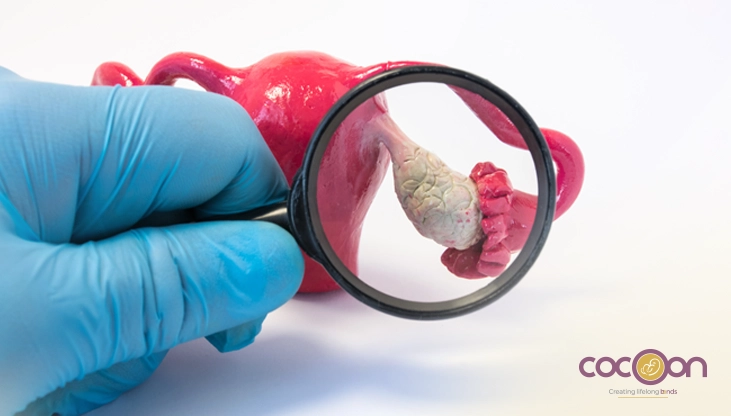
Surgical options for treating women's health conditions, such as endometriosis, uterine fibroids, ovarian cysts, tubal ligation, etc., have evolved significantly over the years. Experts at the best maternal care center, like Cocoon Hospital, are adopting advanced techniques like minimally invasive surgery, such as laparoscopy.
Laparoscopic, a modern technology, has given access to safer and more effective treatment because of its less invasive nature; think of it like fixing things inside your house through a small keyhole instead of breaking down an entire wall.
However, one question still remains: Should you totally rule out the traditional open surgery method?
The answer is simple: Laparoscopic and traditional surgery have their own benefits, and your doctor will choose which one is best for you. Think of it like choosing the suitable path for a journey; sometimes a shorter and smoother path works perfectly, while in some scenarios a broader and more direct path is crucial for you to reach the destination safely.
Continue to read to know in more detail:
Read Also: Recovering After Laparoscopic Surgery: Dos and Don'ts
What is Laparoscopic Surgery “Keyhole Surgery”?
It is a minimally invasive technique that your surgeon performs to look for issues in your stomach or pelvic area and fix them.
It involves the use of a tool called a laparoscope, which is a thin, telescopic rod with a video camera on the end. Your surgeon introduces the laparoscope via a small cut (0.5–1.5 cm incision) in your belly (abdomen) to determine the actual issues.
Difference Between Laparoscopy and Laparoscopic Surgery
Both are almost similar. But instead of looking for medical issues, in laparoscopic surgery, your surgeon uses a laparoscope and surgical instruments to operate on your internal organs. Individuals often use the terms interchangeably.
"Laparoscopy" derives from Greek roots: "lapara," meaning "flank" or "abdomen," and "skopeo," meaning "to see."
What Is Laparoscopic Surgery Used For?
Your doctor might recommend a laparoscopy if other diagnostic tests can’t identify the actual cause of your condition.
It is used in the following conditions:
- Gynaecological surgeries such as the removal of cysts or fibroids, tubal ligation, and endometriosis treatment.
- Gastrointestinal surgeries such as gallbladder removal, appendix removal, and treating Crohn's disease.
- Ectopic pregnancy removal.
- Gastric bypass surgery.
- Cholecystectomy (gallbladder removal) for gallstones.
- Appendectomy (appendix removal).
- Urethral and vaginal reconstruction surgery.
Benefits of Laparoscopic Surgery
Here are the key benefits:
- A shorter hospital stay.
- Faster recovery time.
- Quicker return to your usual activities.
- Less pain during healing.
- Less need for pain medication.
- Smaller scars.
- Less risk of infection.
- Less trauma to the inside of the belly.
- Less blood loss.
- A lower risk of hemorrhage.
Possible Risks or Complications
This keyhole surgery is a safe and effective technique if done under professional care. However, like any other procedure, sometimes it can lead to the following complications:
- Bleeding at the site of incision.
- Injury to nearby organs and blood vessels.
- Anesthesia risk.
- Infection.
- Abdominal swelling.
- Clotting in the legs, pelvis, or lungs.
Read Also: Laparoscopy In Gynecology: A Safer & Faster Approach To Surgery
What is Laparotomy “Open Traditional Surgery”?
It is a surgical procedure that opens up your abdomen to expose your organs.
The term “laparotomy” means an incision through the abdominal (belly) wall that opens up your peritoneal cavity (that includes the abdomen and pelvis).
What Is Laparotomy Used For?
Your doctor may recommend this invasive method to know the real cause of the problem, such as unexplained abdominal pain or internal bleeding, if they are unable to find it on imaging tests or laparoscopy.
It is used in the following conditions or procedures:
- Gynaecological issues.
- Immediate life-threatening conditions such as acute abdominal injuries, ruptured organs, or significant internal bleeding.
- Gastrointestinal conditions.
- Ovarian cystectomy for ovarian cysts or ovarian endometrioma.
- Endometriosis staging and treatment (endometriosis surgery).
- Whipple procedure or total pancreatectomy for pancreatic cancer.
- Ovarian cancer staging and treatment.
- Hodgkin lymphoma staging and treatment.
- To treat deep infections or abscesses in the abdominal cavity.
Benefits of Laparotomy
Here are the key benefits:
- Can be important in life-threatening situations.
- Provide surgeons with direct, comprehensive access to the abdominal cavity.
- Necessary approach for complex surgeries.
- Useful in certain body types (like extreme obesity) or unusual body structure.
Possible Risks or Complications
If recommended, it is a safe procedure, but it can have the following disadvantages or risks:
- Large incision.
- Unintended injury to adjacent organs.
- Excessive bleeding from injured blood vessels.
- Wound infection.
- Delayed healing.
- Bowel obstruction because of abdominal adhesions.
Read Also: All You Need to Know About Laparoscopic Myomectomy
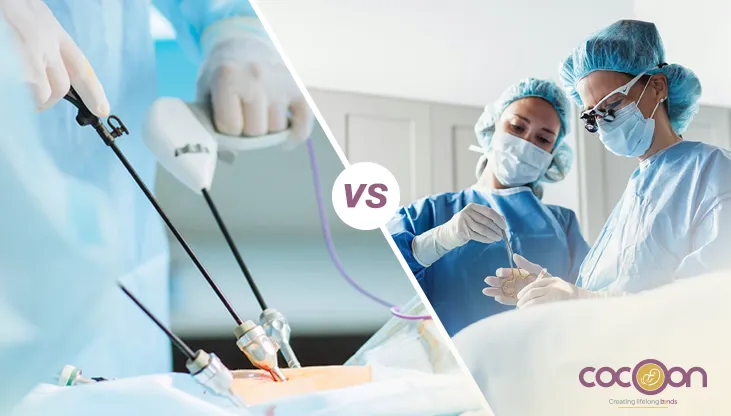
Laparoscopic Surgery Benefits vs Open Surgery
Here is the key difference:
| Aspect | Laparoscopy | Traditional Surgery |
| Incision Size | Small (0.5-1 cm keyhole) | Large (6-8 inches) |
| Recovery Time | Laparoscopy surgery recovery time: Around 2-4 weeks | Laparotomy surgery recovery time: Around 6-8 weeks |
| Pain Level | Less postoperative pain | More pain, higher analgesic needs |
| Scarring | Minimal, less visible | Larger, noticeable scars |
| Hospital Stay | Shorter (often day surgery) | Longer |
| Infection Risk | Lower due to small wounds | Higher from larger exposure |
| Cost | Diagnostic Laparoscopy: ₹20,000 – ₹50,000 Laparoscopic Appendectomy: ₹30,000 – ₹1,00,000 Laparoscopic Gallbladder (Cholecystectomy): ₹40,000 – ₹1,20,000 Laparoscopic Hysterectomy: ₹60,000 – ₹2,50,000 |
Average Cost: ₹33,250 – ₹65,500 Open Gallbladder Surgery: ₹54,000 – ₹90,000 |
Read Also: Laparoscopic Cholecystectomy Surgery In Jaipur – Safe & Effective
What Is the Conclusion for You?
Both are safe and effective when performed under professional advice. Your doctor knows which technique to use based on the type and severity of your condition.
When Is Laparoscopy Recommended?
Doctors usually recommend laparoscopy when:
- The condition is not too advanced
- The patient is stable
- The surgeon has adequate expertise
- Minimal invasion is possible
When Is Traditional Surgery Necessary?
Traditional surgery may be required in the following situations:
- Very large fibroids or tumors
- Advanced gynecological cancers
- Severe internal bleeding
- Extensive adhesions from previous surgeries
- Emergency conditions
In some cases, a procedure may start as a laparoscopy but convert to open surgery if complications arise.
One size does not fit all; take an informed decision with your doctor.
Consider Laparoscopy If:
- You want faster recovery
- Your condition is not severe
- You prefer minimal scarring
- A trained laparoscopic surgeon is available
Consider Traditional Surgery If:
- The condition is complex or advanced
- There is a need for direct access
- Emergency intervention is required
Read Also: Laparoscopic Hysterectomy in Jaipur – Recovery & Cost
FAQs
Q1: What is the laparoscopy surgery recovery time compared to open surgery?
A: The recovery time varies based on individual factors. Laparoscopy recovery is 2–4 weeks, with light activity in 3–7 days. Open surgery takes 6–8 weeks due to larger incisions, more pain, and slower healing.
Q2: What is the laparoscopy cost in India for gynaecological procedures?
A: Laparoscopy in India costs ₹20,000–₹50,000 (diagnostic), ₹50,000–₹1,00,000 (infertility), and ₹60,000–₹2,50,000 (hysterectomy), varying by city, hospital, and procedure complexity.
Q3: What are the main laparoscopic surgery benefits vs. open surgery for women's health?
A: Benefits include smaller scars, less pain, minimal blood loss, shorter stays (1–3 days), and quicker recovery. Open surgery suits complex cases but involves longer recovery and higher risks.
Q4: When is laparoscopy recommended over open surgery for fibroids or endometriosis?
A: Your doctor may recommend the best option for you. Laparoscopy suits early-stage fibroids, endometriosis, or cysts for faster recovery and fertility preservation. Open surgery is preferred for large tumors, advanced cancer, or emergencies.
Q5: What are the risks of laparoscopic surgery vs. open surgery?
A: Both are safe methods if done under professional guidance. However, like any other procedure, they can also carry risks.
Laparoscopy risks include rare organ injury, bleeding, or conversion to open. Open surgery has higher risks of infection, blood loss, and adhesions; both are safe with skilled surgeons.