 08929816349

Pregnancy is a lovely journey that fills you with joy, anticipation, and perhaps a touch of uncertainty, especially about keeping track of how far along you are. You might hear your doctor say you’re “14 weeks pregnant,” while family members ask, “So how many months?”
Quick Answer: Pregnancy is measured in weeks from the first day of your last menstrual period (LMP) because it provides more precise tracking of fetal development. 40 weeks equals approximately 9 months and 1 week, not exactly 9 months.
If you’re confused about how pregnancy weeks turn into months or what happens at each stage, you’re not alone. This guide gives you exact week-to-month conversions, trimester milestones, lab tests, and expert tips to stay on track.
Read Also: Pregnancy Tips For First-Time Moms
Why is Pregnancy Calculated in Weeks, Not Months?
Direct Answer: Doctors use weeks instead of months because weeks provide consistent, precise tracking of fetal development and maternal changes that vary week by week.
Pregnancy is normally 40 weeks, from the first day of your last menstrual period (LMP)—even if you were not pregnant yet. This is because ovulation and getting pregnant naturally occur at week 2.
Read Also: How Wellness Programs Help Mothers During Pregnancy
How Do You Count Pregnancy Weeks from Last Menstrual Period (LMP)?
It starts with the LMP. If you know the first day of your last period, that's week 1 of pregnancy. From there, you just count forward.
If your LMP was January 1st and the current date is March 1st, you're approximately 9 weeks pregnant. While conception may have been around mid-January, doctors still use LMP to maintain uniformity.
You can also use an online Pregnancy Weeks Calculator where you enter your LMP and it'll automatically tell you how many weeks pregnant you are.
Don’t Know Your LMP?
If you have irregular cycles or don’t remember your LMP:
- Your doctor will use an early dating scan (6–9 weeks) to estimate gestational age
- First-trimester ultrasound is ±5–7 days accurate
- Pro Tip: Use our
- Pregnancy Weeks Calculator
- (enter your LMP for instant results).
Read Also: Anemia During Pregnancy: Symptoms, Risks & Prevention
What Are the Pregnancy Trimesters?
Pregnancy is divided into three trimesters:
- First Trimester: Week 1 to Week 12
- Second Trimester: Week 13 to Week 26
- Third Trimester: Week 27 to Week 40
Every trimester involves differing changes in your body, the baby's growth, and some tests your doctor may order.
| Trimester | Weeks | Duration | Key Changes |
| First | 1–12 | ~3 months | organ formation, nausea, fatigue, confirming pregnancy |
| Second | 13–26 | ~3.5 months | energy returns, baby bump appears, fetal movement starts |
| Third | 27–40 | ~2.5 months | rapid growth, baby positioning, preparation for labor |
Read Also: Essential Tips & Preparation for a Smooth Normal Delivery
How Are Pregnancy Weeks Equivalent to Months?
Weeks convert to months approximately, not exactly, because months don’t divide evenly into 40 weeks.
| Weeks | Month | Trimester | Key Milestones |
| 1–4 | 1st Month | First | Implantation, missed period, positive test |
| 5–8 | 2nd Month | First | Heartbeat visible (6 weeks), organ formation |
| 9–13 | 3rd Month | First | NT scan (11–13 weeks), reduced nausea |
| 14–17 | 4th Month | Second | Gender may be visible, energy returns |
| 18–21 | 5th Month | Second | Fetal movement (quickening), anomaly scan (18–20) |
| 22–26 | 6th Month | Second | Viability threshold (24 weeks), glucose test (24–28) |
| 27–30 | 7th Month | Third | Growth scan (28–32), positioning begins |
| 31–35 | 8th Month | Third | Frequent checkups, Group B Strep test (35–37) |
| 36–40 | 9th Month | Third | Full term (39–40 weeks), labor preparation |
Note: This is an estimate. Confirm your exact week with an ultrasound dating scan, especially if you have irregular cycles.
Term Classification (ACOG Guidelines):
- Preterm: Before 37 weeks
- Early term: 37–38 weeks 6 days
- Full term: 39–40 weeks 6 days
- Late term: 41–41 weeks 6 days
- Post term: After 42 weeks
Read Also: Luxury Birthing: What Makes a Premium Maternity Experience
What Are the Lab Tests Conducted During Pregnancy?
We can go trimester by trimester so that you are prepared for each step of the way.
Read Also: Trimester-by-Trimester Pregnancy Health Checklist
What Tests Are Done in the First Trimester (Weeks 1–12)?
First-trimester tests confirm pregnancy, assess maternal health, and detect early complications.
1. Blood Tests and Urine Tests: These are normally done in your first prenatal appointment. These screen for:
- Hormone (hCG) levels in pregnancy
- Blood group and Rh factor
- Hemoglobin (for anemia)
- Blood sugar
- Infections (like HIV, hepatitis B, syphilis)
- Urine tests for sugar, protein, and infection
2. Thyroid Function Tests: An overactive or underactive thyroid can affect the brain development of the baby, so it is necessary to test early.
3. Ultrasound (Dating Scan): This is typically done 6–9 weeks pregnant to confirm the pregnancy and determine the due date. You will be able to see your baby's small heartbeat for the first time, a very emotional experience for most parents.
4. Double Marker Test & NT Scan (Week 11–13): These check for chromosomal abnormalities like Down Syndrome. They are not compulsory but recommended in women over the age of 30 or those with a history of such conditions in their families.
| Test | Timing | Purpose |
| Blood & Urine Tests | 6–9 weeks | hCG levels, blood group/Rh, hemoglobin (anemia), blood sugar, HIV/hepatitis B/syphilis, urine protein/sugar/infection |
| Thyroid Function Test (TSH) | 6–9 weeks | Detect hypo/hyperthyroidism (affects baby’s brain development) |
| Dating Scan (Ultrasound) | 6–9 weeks | Confirm pregnancy, due date, heartbeat (first emotional moment!) |
| Double Marker + NT Scan | 11–13 weeks | Screen for chromosomal abnormalities (Down syndrome); recommended for age ≥30 or family history |
Read Also: Natural Birth vs. C-Section: Choosing the Best Option for You
What Happens in the Second Trimester (Weeks 13–26)?
This is generally the most comfortable time for mums. Energy levels return, nausea reduces, and you start showing a baby bump.
1. Quadruple Marker Test (Week 15–20): A second-trimester test that screens for birth defects, including neural tube defects like spina bifida.
2. Anomaly Scan (Week 18–20): This detailed ultrasound scans your baby's organs, bones, heart, and brain. It also tells you the sex of the baby (if allowed by law in your country).
3. Glucose Tolerance Test (Week 24–28): This is done to test for gestational diabetes, a condition affecting blood sugar levels in pregnancy. If detected, it can be controlled by diet or insulin.
4. CBC and Urine Routine: These are normally repeated to monitor your health and catch any infection or anemia early.
| Test | Timing | Purpose |
| Quadruple Marker Test | 15–20 weeks | Screen for neural tube defects (spina bifida) and chromosomal issues |
| Anomaly Scan (Level II Ultrasound) | 18–20 weeks | Detailed scan of baby’s organs, bones, heart, brain; sex disclosure (if legally allowed) |
| Glucose Tolerance Test (GTT) | 24–28 weeks | Detect gestational diabetes; controlled via diet or insulin if positive |
| CBC + Urine Routine | 24–28 weeks | Repeat to monitor anemia, infection, overall health |
What About the Third Trimester (Weeks 27–40)?
As your baby gets ready to arrive, your doctor will pay attention to the position of the baby, the weight, and your readiness for giving birth.
1. Growth Scan (Week 28–32): An ultrasound to monitor baby's growth, position of the placenta, and amniotic fluid levels.
2. Doppler Test: Sometimes combined with a growth scan to monitor blood flow from the placenta to the baby.
3. CBC, Urine, and Blood Sugar Tests: These tests are done again to check on your health, especially if you had gestational diabetes or anemia in the past
4. Group B Strep Test (Week 35–37): This vaginal swab checks for any bacteria you may have. If you test positive, during labor you will receive antibiotics to prevent passing it to your baby.
| Test | Timing | Purpose |
| Growth Scan | 28–32 weeks | Monitor baby’s size, placenta position, amniotic fluid levels |
| Doppler Test | 32–36 weeks (if needed) | Check blood flow from placenta to baby |
| CBC, Urine, Blood Sugar | 32–36 weeks | Repeat to catch late anemia, infection, or gestational diabetes |
| Group B Strep (GBS) Test | 35–37 weeks | Vaginal swab; if positive, receive IV antibiotics during labor to protect baby |
How Can You Stay on Track with Your Pregnancy Timeline?
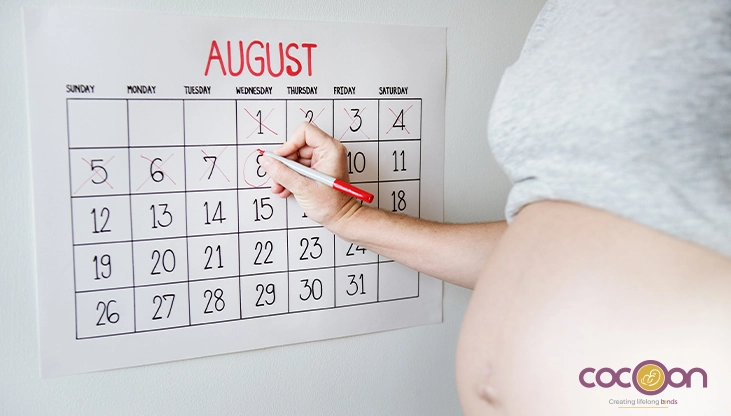
Keeping a pregnancy journal, using an app, or simply crossing off your calendar week by week keeps you on track with your prenatal appointments and tests. Reminders will also help emotionally connect you to the growth of your baby, be it feeling the first kick or glimpsing that little nose during an ultrasound.
What If You Don't Know Your LMP or Have Irregular Cycles?
Don't worry! If you don't know when you last had your period or have an irregular cycle, your doctor will calculate how far along you are based on an early scan. This is referred to as a dating scan, and it is very precise if performed at the first trimester.
When Do You Actually Give Birth: At 9 or 10 Months?
This is another topic that misleads many. Technically, pregnancy is 40 weeks, which is roughly 9 months and 1 week. So, though we talk about "9 months pregnant," it's really a little more than that.
Some women have their babies at 37 weeks (early full term), whereas others take even up to 41 weeks. Your due date is only an estimate—your baby will show up when they're ready!
How Can Partners Assist Along This Timeline?
This process isn't solely the mom's dads and partners are an integral part of it. Here's how you can be a part of it:
- Participate in doctor visits and ultrasounds
- Help with keeping weeks and scheduling tests
- Be a supportive listener when symptoms become difficult
- Celebrate baby's milestones week by week
The journey is all the more special when both partners embark on it hand in hand.
| Way to Help | Why It Matters |
| Attend doctor visits & ultrasounds | Shared bonding, ask questions together |
| Help track weeks & schedule tests | Reduce mom’s mental load |
| Be a supportive listener | Hormones + symptoms = emotional ups and downs |
| Celebrate milestones together | First kick, anatomy scan, nesting make it special |
Conclusion
Pregnancy is not just a matter of weeks and waiting for due dates—it's about embracing every little thing as you prepare to welcome home a new life.
Understanding how weeks turn into months, what tests you'll need, and what to watch for will make you feel more confident and less anxious. But most importantly, regular laboratory tests and check-ups throughout your pregnancy ensure you and baby stay healthy throughout.
At 6 weeks or 36 weeks, whichever that is for you, with every heartbeat, every kick, and every ultrasound, each one of them is a beautiful page of your book.
Best Natural Childbirth Hospital Near Me in Jaipur | Cocoon Hospital
Cocoon Hospital facility is backed by advanced technologies, 4D ultrasound and diagnostic imaging, and high-end labour, delivery, and recovery (LDR) suites that ensure painless, natural childbirth. We can proudly say that we have welcomed over 19,000 babies into the world, maximising safety through high-end monitoring.
We stand out as the top choice for safe, natural birth in Jaipur because of the following qualities.
- Board-certified gynaecologists with 20+ years in natural deliveries.
- Personalised plans aligned with a patient-centric approach.
- Top-notch amenities such as lactation rooms, baby spas, and castle-inspired birthing suites in our luxury birthing package.
- Affordable, transparent pricing.
- We offer prenatal programs, nutrition counseling, and antenatal yoga.
Our Experts:
- Dr. Himani Sharma
- Dr. Mitul Gupta
- Dr. Anupama Gangwal
- Dr. Preeti Sharma
- Dr. Priya Gupta
What People Say About Us
We have a high patient satisfaction rate. You can witness the proof by watching the memorable experience of Mrs. Harvinder Kaur welcoming her baby boy at Cocoon Hospital. We are proud to be rated 4.7 stars on Google, based on 3,297 patient reviews, showcasing our commitment to exceptional maternal and child care in Jaipur.
Book your free consultation today; contact us at contactjpr@cocoon.co.in; 08929816349.
FAQs
Q1. Why is pregnancy measured in weeks instead of months?
A: Pregnancy is measured in weeks because it provides more precise tracking of the baby’s development and key milestones, which can vary week by week.
Q2. How do you calculate pregnancy weeks?
A: Pregnancy is calculated from the first day of your last menstrual period (LMP), and you simply count forward in weeks from that date.
Q3. How do pregnancy weeks convert into months?
A: Weeks are grouped approximately into months (e.g., weeks 1–4 = month 1, weeks 5–8 = month 2), but this is an estimate since months don’t divide evenly into weeks.
Q4. When is a baby considered full term?
A: A baby is full term at 39–40 weeks 6 days. Early term is 37–38 weeks 6 days, and late term is 41 weeks.
Q5. What if I have irregular periods and don’t know my LMP?
A: Your doctor will use a first-trimester dating scan (6–9 weeks) to estimate gestational age with ±5–7 days accuracy.