 08929816349
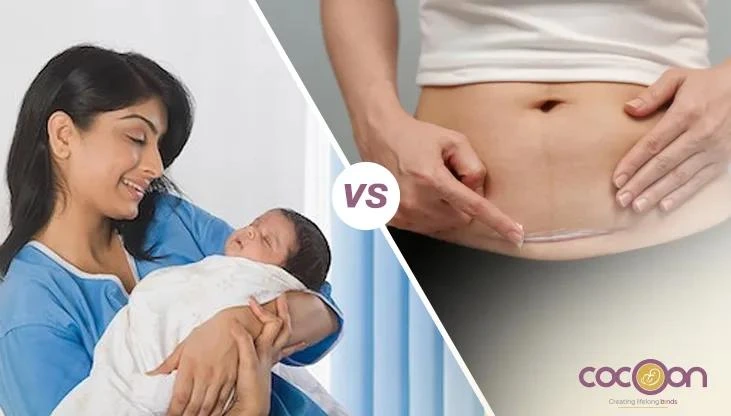
For many expecting mothers, the most crucial question that they keep asking is, 'Should I opt for a normal delivery or a C-section?' While social opinions and personal preferences may vary, the decision for the right choice (C-section vs normal delivery, which is better) should be made in consultation with your doctor based on one key factor: the safety of both mother and baby. Because keep in mind, both methods are valid, safe options when guided by an obstetrician-gynaecologist (OB-GYN).
Read Also: Essential Tips & Preparation for a Smooth Normal Delivery
What is Normal Delivery
Normal delivery is also known as vaginal delivery. In this, the baby is born through the vagina or birth canal. Because it carries the lowest risk, in most instances, vaginal delivery is the most preferred and most common way to deliver a baby.
Normal delivery has 3 stages:
- Labor
- Birth
- Delivering the placenta
There are 3 types of vaginal delivery:
- Spontaneous vaginal delivery: Happens on its own. No labor-inducing drugs are used.
- Induced vaginal delivery (labor induction): Drugs or other techniques start labor and prepare the cervix.
- Assisted vaginal delivery: It happens with the help of forceps or a vacuum device to get the baby out safely.
Note: Both spontaneous and induced vaginal delivery can be assisted.
Read Also: Normal Delivery Hospital in Jaipur – Safe Natural Birth
Is Normal Delivery Safe
Yes, in most cases, when recommended and guided by medical expertise, it is a safe option because of several benefits.
Benefits of Normal Delivery
This method leverages the body's hormones like oxytocin to progress naturally. Following are normal delivery benefits for a mother:
- Faster recovery.
- Safest for mother and newborn.
- Lower rates of infection.
- Reduced the chance of future pregnancy complications.
- Lactation and breastfeeding are generally easier.
- Benefits for the babies: they are at lower risk for respiratory problems and have a stronger immune system. More likely to breastfeed.
When Vaginal Delivery is Avoided
It is not an ideal choice in the following situation:
- Baby is in a breech position.
- If the mother has placenta previa or a problem with your placenta.
- Untreated infection or open genital lesions from herpes simplex virus.
- Maternal chronic health condition.
- Haemorrhage or excessive bleeding.
- Fetal distress.
- Labor isn’t progressing.
- Umbilical cord prolapse.
- Placental abruption.
Read Also: Painless Delivery Hospital in Jaipur – Cost & Care
What is C-Section
A Caesarean section, C-section, or Caesarean birth, is the surgical delivery of a baby through a cut (incision) made in the birth parent's abdomen and uterus. Obstetrician-gynaecologists (OB-GYN) use it when they believe it's safer for the birth parent, the baby, or both.
The incision made in the skin may be:
- Up-and-down (vertical)
- Across from side-to-side (horizontal)
Is Cesarean Section Safe?
Yes, when recommended and guided by medical expertise, it is a safe option because of several benefits.
Benefits of C-Section
Here are the advantages:
- Decreased risk of the baby having trauma from passing via the vagina.
- Less risk of the baby being oxygen-deprived during delivery.
- Possible lower risk of incontinence (the involuntary or accidental loss of bladder) or sexual dysfunction.
When Will a Doctor Recommend a C-Section?
Several conditions make a cesarean delivery more likely. These include:
- Abnormal fetal heart rate.
- Abnormal position of the fetus during birth.
- Labor that fails to progress or doesn't progress the way it should.
- The baby is too large to deliver vaginally.
- Placenta previa.
- Maternal chronic health conditions such as diabetes, high blood pressure, or HIV infection.
- Active herpes sores in the mother’s vagina or cervix.
- Twins or other multiples.
- Previous C-section.
- Umbilical cord prolapse.
Read Also: VBAC Delivery Hospital in Jaipur – Normal Delivery After C-Section
Pain in Normal Delivery vs C-Section
Both have specific pain duration. Normal delivery involves strong labour pains during contractions but less pain after safe delivery. A C‑section has less pain during surgery but more post‑operative incision pain and recovery takes time.
Read Also: Natural Birth vs. C-Section: Choosing the Best Option for You
Normal Delivery vs C-Section Which Is Better
There is no single “better” option C-section vs normal delivery; the safest choice depends on the mother’s health, fetal condition, and other individual factors.
| Aspect | Normal (Vaginal) Delivery | C‑Section (Caesarean) Delivery |
| Procedure type | Natural, non‑surgical vaginal birth | Surgical birth through the abdomen and uterus (womb) |
| Normal delivery vs c-section recovery time | Usually faster (2–6 weeks), early mobility | Slower (typically 6–8 weeks), more rest, and limitation of activity |
| Hospital stay | Shorter, often 1–2 days if uncomplicated | Longer, usually 3–5 days or more |
| Pain pattern | Labour pain during contraction, but less after birth | Less pain during surgery (under anaesthesia), but post-surgical discomfort at the incision |
| Benefits (mother) | Faster recovery and mobility. Lower risk of surgical complications. No abdominal scar |
Avoids prolonged or obstructed labour pain Planned timing can reduce stress and anxiety in high-risk cases |
| Benefits (baby) | Better lung fluid clearance, healthy microbiome | Lifesaving in emergencies: controlled timing |
| Risks to mother | Possible perineal tearing, episiotomy, pelvic floor strain; fewer surgical risks | Risk of infection, blood loss, blood clots, scar‑tissue adhesions, and a higher risk in future surgeries |
| Risks to the baby | Natural lung fluid clearance and gut microbiome benefit from birth‑canal exposure | Slightly higher risk of breathing issues, especially if preterm or early term |
| Planning & timing | Starts when labour begins; timing is unpredictable | Can be scheduled in advance, useful for high‑risk or planned deliveries |
| Normal delivery vs c-section cost | Generally lower (no surgery or extended stay) | Generally higher (surgery, anaesthesia, longer stay) |
| Future pregnancies | Usually fewer restrictions; vaginal birth in future is often possible | Multiple C‑sections may increase risks and may lead to recommendations for future planned C‑sections |
| Best suited for | Low‑risk pregnancies without complications | High‑risk pregnancies, breech / twins, placenta previa, or emergencies during labour |
Conclusion
There is no universal “best” choice; only the safest choice is based on the maternal and baby-specific situation. All you need is to take an informed decision with your doctor and follow their advice.
FAQs
Q1: Normal delivery vs c section ratio in india?
A: In India, about 70–75% of births are normal deliveries and 25–30% are C-sections. The estimates can vary based on the year. C-section rates are rising.
Q2: What are the c-section vs normal delivery pros and cons?
A: A C‑section gives controlled timing and safety in high‑risk cases but after delivery it has a longer recovery and risks.
Normal delivery is known for faster recovery and fewer complications but involves labour pain and unpredictability.
Q3: Which has more blood loss, normal or C-section?
A: Both methods can lead to postpartum hemorrhage (PPH) if excessive; however, in most cases normal delivery usually has less blood loss
Q4: What is the c-section vs normal delivery percentage?
A: The prevalence of C-sections across India increased from 17.2% to 21.5% in the 5 years leading up to 2021. But normal delivery is still more common overall.