Those first 3 months with your newborn can feel like learning a new language from scratch. Every cry and tiny movement seems different from the previous week or month, making you wonder if it's normal.
One day your baby sleeps almost all day, and the very next day they might be staring at your face with curious little eyes or trying to express their very first smile.
If you're seeking information on what newborn development looks like in the first three months,
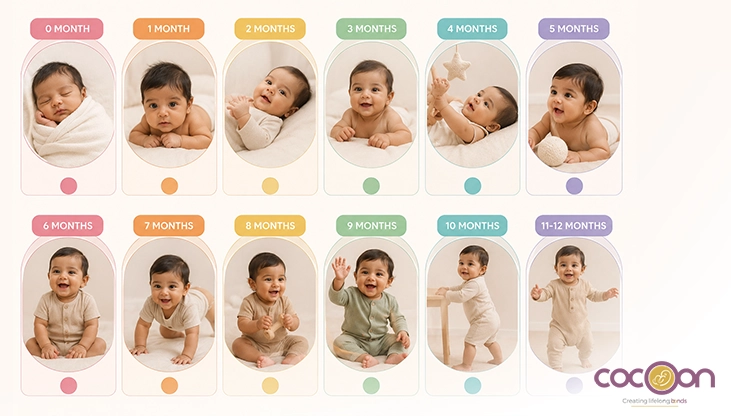
Here is the answer for you: Your baby will develop in their own unique way at their own pace to adapt to life outside the womb. They will rapidly develop physically, emotionally, and mentally. During this period, babies slowly gain better head control, respond to familiar voices, start making eye contact, smile socially, and learn to use their hands.
Babies learn from information such as their caregivers' body language, expressions, and how they're held. However, the way new babies communicate their necessities is primarily by crying. By age 2 months, your baby may coo and mimic vowel sounds when you talk or gently play together.
As they grow at their own pace, don't make the mistake of comparing your little one with babies on social media or even neighbouring kids and siblings. Think of it like growing a garden. Some flowers bloom earlier; others take a little longer, but when provided with proper care, sunlight, and patience, they all mature in a beautiful manner in their own time.
Quick Overview: Baby Development by Month
| Age | Physical Development | Social & Emotional | Communication | Cognitive Development |
| Birth–1 Month | Reflexive movements, slight lifting of head | Respond to familiar voices | Communicate their needs is mostly by crying | Watches faces and bright objects |
| 2 Months | Better head control and opens hands | Smile socially | Begins cooing | Tracks moving objects |
| 3 Months | Raise their head and chest when lying on their stomach. They can grasp toys | Enjoy to interact | Start testing out other sounds, such as squeaks, growling or blowing raspberries | Recognizes caregivers and follows objects |
The first three months are often referred to as the "fourth trimester". The term was coined by pediatrician and author Dr Harvey Karp.
Although your baby has entered this world, many body systems are still in the developmental phase. For example, your baby's brain is forming millions of new neural connections every day through cuddles, conversation, smiles, and gentle touch.
Instead of mastering one skill at a time, your baby is developing in several important areas, such as:
- Physical growth
- Brain development
- Motor skills
- Vision and hearing
- Emotional bonding
- Language development
- Sleep and feeding patterns
What Are the Newborn Milestones in the First 3 Months?
Let's explore the baby development and growth by month:
1. Birth to 1 Month
The first month is all about adjusting to life outside the womb.
Babies are mostly sleeping and feeding most of the time. As a 1-month-old, babies start to know familiar sounds and may show it by turning their head.
Common newborn milestones
- Sleeps 14–17 hours per day
- Recognizes parents' voices
- Focuses on faces from close distances
- Uses reflexes such as sucking and grasping
- Moves arms and legs randomly
- Briefly lifts the head during tummy time
2. 2 Months
By the second month, many babies are noticeably more alert.
Common newborn milestones
- Holds head up when on tummy
- Spend a few seconds looking at a specific object, like a toy
- Moves both arms and both legs
- Opens hands briefly
- Watch your movements and make noises besides crying
- Move their arms and legs
- Open up their hands for a few seconds at a time
- React if there’s a loud noise around them
- Stop crying or calm down when you talk to them or pick them up
- Look at your face and react happily to seeing you
- Begin to smile when others smile at them
3. 3 Months
Babies get stronger, more interactive, and substantially more aware of the people around them.
Common newborn milestones
- Raise their head and chest when lying on their stomach
- Keep their head in the middle when lying on their back
- A baby may respond to these sounds with excitement
- Your baby may quiet down to listen to your voice
- By the end of month three, your baby can make eye contact and may begin to tell colors apart
- Supports head better when held
- Grasps toys briefly
- Brings hands to mouth
How Can Parents Support Baby Development?
Your relationship with your newborn is the foundation of their development; hence, parents should follow the following tips to make the baby's learning process smooth.
Here are the simple 8 tips that can support baby’s development:
- Skin-to-skin contact helps brain development.
- Talk to your baby and change your expression and tone of voice.
- Read books, sing lullabies, or simply narrate your day.
- Do not abandon them in supported seating for too long.
- Give your baby regular ‘tummy time'.
- Avoid overstimulation such as too much noise, bright lights, or constant activity.
- Give them the toys that are strong, don’t come apart, aren’t sharp and are larger than your baby’s mouth.
- Respond to their crying.
What Changes During the First 3 Months?
Healthy newborn growth can include the following changes:
- Height
- Head circumference
- Brain development
- Muscle strength
- Sensory development
- Regain birth weight within two weeks
- Grow roughly around 1 inch (2.5 cm) per month during early infancy
- Develop stronger neck muscles per week
What are the Milestones in Motor Skill Development By Month
Here is the typical motor skill growth in babies by the end of the third month:
| Skill | Birth | 2 Months | 3 Months |
| Head control | Minimal | Improving | Holds head briefly |
| Hand movements | Mostly closed fists | Opens hands | Grasps objects |
| Tummy time | Brief lifting | Stronger neck | Lifts chest using elbows |
| Body movement | Reflexive | More coordinated | Controlled kicking |
What is the Language & Communication Development by the End of 3rd Month?
A child’s communication develops in stages.
Birth
- New babies communicate their needs mostly by crying.
Around 2 months
- A baby might coo and repeat vowel sounds when you talk or gently play together
- Vowel sounds become common.
Around 3 months
- Start testing out other sounds, such as squeaks, growling or blowing raspberries.
- Babies imitate facial expressions.
- They respond during "conversations."
The simplest way to support a baby's language development is by talking to them throughout everyday activities.
Describe what you're doing:
- "Let's change your diaper."
- "Here's your bottle of milk."
- "Look at the bird."
- "Look, it’s raining.”
When to Contact Your Doctor
Talk to your baby's doctor if you notice any of these red flags:
- Difficulty feeding.
- Doesn't respond to loud sounds.
- Seems stiff and rarely moves arms or legs, or the arms or legs are very floppy.
- Doesn't track moving objects with the eyes.
Conclusion
Between 1 and 3 months of age, your baby will undergo a profound transformation from a totally dependent newborn to a more active and responsive infant. All you need is to help develop a supportive environment where they can develop their mental, physical, and emotional intelligence.
Celebrate the little victories, enjoy the quiet moments, and remember to give love, attention, and regular ‘tummy time' for supporting healthy newborn development.